Document#
- class aastex.Document(default_filepath='default_filepath', documentclass='aastex631', document_options=None, fontenc='T1', inputenc='utf8', font_size='normalsize', lmodern=True, textcomp=True, microtype=None, page_numbers=True, indent=None, geometry_options=None, data=None)[source]#
Bases:
DocumentAttributes
Start a new paragraph before this environment.
Start a new paragraph after this environment.
Determine whether or not to escape content of this class.
Return the name of the class used in LaTeX.
Set to true if this full container should be equivalent to an empty string if it has no content.
Same as enabling begin_paragraph and end_paragraph, so effectively placing this element in its own paragraph.
Methods
__init__([default_filepath, documentclass, ...])add_color(name, model, description)Add a color that can be used throughout the document.
append(item)S.append(value) -- append value to the end of the sequence
change_document_style(style)Alternate page style for the entire document.
change_length(parameter, value)Change the length of a certain parameter to a certain value.
change_page_style(style)Alternate page styles of the current page.
clear()copy()count(value)create(child)Add a LaTeX object to current container, context-manager style.
dump(file_w)Write the LaTeX representation of the class to a file.
dump_packages(file_w)Write the LaTeX representation of the packages to a file.
dumps()Represent the document as a string in LaTeX syntax.
Create a string representation of the object as content.
dumps_content(**kwargs)Represent the container as a string in LaTeX syntax.
Represent the packages needed as a string in LaTeX syntax.
extend(other)S.extend(iterable) -- extend sequence by appending elements from the iterable
generate_pdf([filepath, clean, clean_tex, ...])Generate a pdf file from the document.
generate_tex([filepath])Generate a .tex file for the document.
index(value, [start, [stop]])Raises ValueError if the value is not present.
insert(i, item)S.insert(index, value) -- insert value before index
pop([index])Raise IndexError if list is empty or index is out of range.
remove(item)S.remove(value) -- remove first occurrence of value.
reverse()S.reverse() -- reverse IN PLACE
set_variable(name, value)Add a variable which can be used inside the document.
set_variable_quantity(name, value[, ...])Similar to
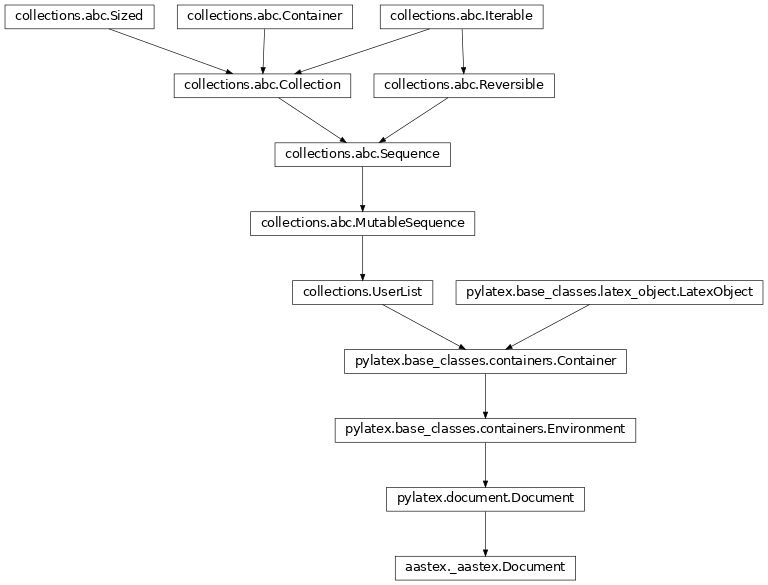
set_variable(), but allows forvalueto be an instance ofastropy.units.Quantity.sort(*args, **kwds)Inheritance Diagram
- Parameters:
- append(item)#
S.append(value) – append value to the end of the sequence
- change_document_style(style)[source]#
Alternate page style for the entire document.
- Parameters:
style (str) – value to set for the document style
- change_length(parameter, value)[source]#
Change the length of a certain parameter to a certain value.
- change_page_style(style)[source]#
Alternate page styles of the current page.
- Parameters:
style (str) – value to set for the page style of the current page
- clear() None -- remove all items from S#
- copy()#
- count(value) integer -- return number of occurrences of value#
- create(child)#
Add a LaTeX object to current container, context-manager style.
- Parameters:
child (~.Container) – An object to be added to the current container
- dump(file_w)#
Write the LaTeX representation of the class to a file.
- Parameters:
file_w (io.TextIOBase) – The file object in which to save the data
- dump_packages(file_w)#
Write the LaTeX representation of the packages to a file.
- Parameters:
file_w (io.TextIOBase) – The file object in which to save the data
- dumps_as_content()#
Create a string representation of the object as content.
This is currently only used to add new lines before and after the output of the dumps function. These can be added or removed by changing the begin_paragraph, end_paragraph and separate_paragraph attributes of the class.
- dumps_content(**kwargs)#
Represent the container as a string in LaTeX syntax.
- Parameters:
**kwargs – Arguments that can be passed to ~.dumps_list
- Returns:
A LaTeX string representing the container
- Return type:
string
- dumps_packages()#
Represent the packages needed as a string in LaTeX syntax.
- Returns:
A LaTeX string representing the packages of the container
- Return type:
string
- extend(other)#
S.extend(iterable) – extend sequence by appending elements from the iterable
- generate_pdf(filepath=None, *, clean=True, clean_tex=True, compiler=None, compiler_args=None, silent=True)[source]#
Generate a pdf file from the document.
- Parameters:
filepath (str) – The name of the file (without .pdf), if it is None the
default_filepathattribute will be used.clean (bool) – Whether non-pdf files created that are created during compilation should be removed.
clean_tex (bool) – Also remove the generated tex file.
compiler (str or None) – The name of the LaTeX compiler to use. If it is None, PyLaTeX will choose a fitting one on its own. Starting with
latexmkand thenpdflatex.compiler_args (list or None) – Extra arguments that should be passed to the LaTeX compiler. If this is None it defaults to an empty list.
silent (bool) – Whether to hide compiler output
- generate_tex(filepath=None)[source]#
Generate a .tex file for the document.
- Parameters:
filepath (str) – The name of the file (without .tex), if this is not supplied the default filepath attribute is used as the path.
- index(value[, start[, stop]]) integer -- return first index of value.#
Raises ValueError if the value is not present.
Supporting start and stop arguments is optional, but recommended.
- insert(i, item)#
S.insert(index, value) – insert value before index
- pop([index]) item -- remove and return item at index (default last).#
Raise IndexError if list is empty or index is out of range.
- remove(item)#
S.remove(value) – remove first occurrence of value. Raise ValueError if the value is not present.
- reverse()#
S.reverse() – reverse IN PLACE
- set_variable(name, value)[source]#
Add a variable which can be used inside the document.
Variables are defined before the preamble. If a variable with that name has already been set, the new value will override it for future uses. This is done by appending
\renewcommandto the document.
- set_variable_quantity(name, value, scientific_notation=None, digits_after_decimal=3)[source]#
Similar to
set_variable(), but allows forvalueto be an instance ofastropy.units.Quantity.- Parameters:
name (str) – The name to set for the variable
value (Quantity) – The value to set for the variable
scientific_notation (None | bool) – Flag controlling whether to use scientific notation. If
None, scientific notation is used ifnp.all(values.abs() < .1)digits_after_decimal (int) – Number of digits to include after the decimal
- Return type:
None
- sort(*args, **kwds)#
- begin_paragraph = False#
Start a new paragraph before this environment.
- content_separator = '%\n'#
- end_paragraph = False#
Start a new paragraph after this environment.
- property escape#
Determine whether or not to escape content of this class.
This defaults to True for most classes.
- property latex_name#
Return the name of the class used in LaTeX.
It can be None when the class doesn’t have a name.
- omit_if_empty = False#
Set to true if this full container should be equivalent to an empty string if it has no content.
- packages = OrderedSet()#
- separate_paragraph = False#
Same as enabling begin_paragraph and end_paragraph, so effectively placing this element in its own paragraph.